SECTION 1: Intro/Disclaimer
Everything on this page is verifiable. Every quote links to its original source — the National Archives, Yale Law School, the Library of Congress. You don’t have to take our word for it. In fact, we’re asking you not to.
Click the links. Read the original documents. See for yourself.
This is The Veritas Paradox: the truth has been hiding in plain sight. The evidence is so complete, so well-documented, that it becomes hard to believe. But it’s real. And now you’ll see it.
SECTION 2: Shays’ Rebellion
In the summer of 1786, farmers in western Massachusetts were losing their land. They couldn’t pay their debts. The courts were seizing their farms and throwing them in prison.
So they fought back.
Daniel Shays, a former captain in the Continental Army, led thousands of farmers to shut down the courts. These weren’t radicals — they were veterans, landowners, citizens who had fought for independence. Now the new government was taking everything they had.
The rebellion was crushed within a year. But it terrified the wealthy elite.
Not because it succeeded. Because it almost did.
Source link:
Learn more: Shays’ Rebellion — George Washington’s Mount Vernon
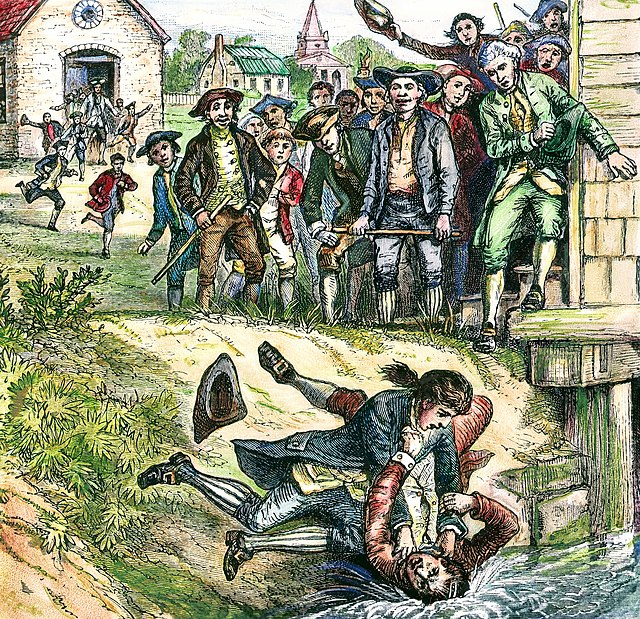
Shays’ protesters taking down a tax collector
SECTION 3: The Reaction
The Wealthy Panic
The news from Massachusetts spread fast. The men who owned the most — land, slaves, bonds, businesses — saw Shays’ Rebellion as an existential threat.
If farmers could shut down courts in Massachusetts, what would stop them in Virginia? In New York? What would stop them from demanding debt forgiveness, land redistribution, paper money?
Source link:
Source: Founders Online, National Archives
Within months, a convention was called in Philadelphia — not to fix the existing government under the Articles of Confederation, but to replace it entirely.
The official purpose was to “revise” the Articles. The real purpose was to build something stronger. Something that could stop the next rebellion before it started.
George Washington, watching from Mount Vernon, wrote to Henry Lee:
“We are fast verging to anarchy and confusion… What stronger evidence can be given of the want of energy in our governments than these disorders?”
— George Washington, October 31, 1786
SECTION 4: Who Was in the Room
The 55 Men Who Designed America
Who were these men in the room?
- Lawyers, merchants, and land speculators
- Creditors — men who were owed money, not men who owed it
- Slaveholders — 25 of the 55 delegates owned enslaved people
- The wealthiest men in their states
Who was not in the room?
- Not one small farmer
- Not one debtor
- Not one laborer
- Not one woman
- Not one enslaved person
- Not one Indigenous American
The men who wrote the Constitution were not “We the People.” They were the elite — and they designed a government to protect their interests from the people.
Source link:
Source: The Founding Fathers — National Archives
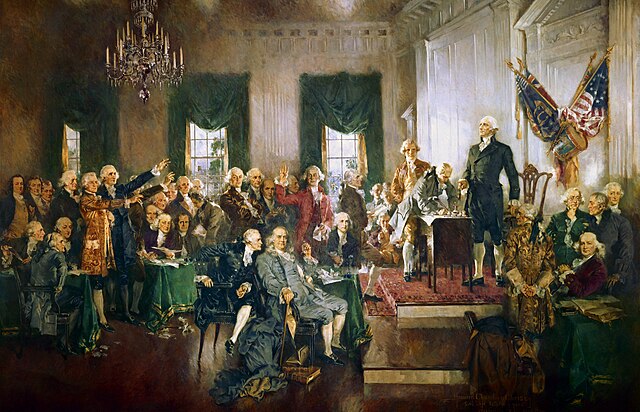
George Washington presiding the Philadelphia Convention
Section 5: What They Said
In Their Own Words
The men who wrote the Constitution didn’t hide their intentions. They wrote them down. They debated them openly — behind closed doors, but recorded in their own notes.
Here is what they said.
James Madison
Madison is called the “Father of the Constitution.” He took detailed notes throughout the Convention. He was explicit about the purpose of the Senate:
“Landholders ought to have a share in the government, to support these invaluable interests, and to balance and check the other. They ought to be so constituted as to protect the minority of the opulent against the majority.”
— James Madison, Constitutional Convention, June 26, 1787
Source: Avalon Project, Yale Law School — Madison’s Notes
Alexander Hamilton
Hamilton was even more direct about who should rule:
“All communities divide themselves into the few and the many. The first are the rich and well born, the other the mass of the people… The people are turbulent and changing; they seldom judge or determine right. Give therefore to the first class a distinct, permanent share in the government.”
— Alexander Hamilton, Constitutional Convention, June 18, 1787
Source: Founders Online, National Archives
Section 6: What They Built
The Machine They Designed
The Constitution wasn’t a compromise. It was an engineering project. Every element was designed to solve a specific problem: how to create a government strong enough to protect property and suppress rebellion, but structured to keep the “common people” away from real power.
Here’s what they built to accomplish:
The Senate
Originally, Senators were not elected by voters. They were chosen by state legislatures — bodies already controlled by wealthy landowners. Senators served six-year terms, insulated from public opinion.
Madison said the Senate would “protect the minority of the opulent against the majority.” It was designed to “cool” the passions of democracy — to slow down or stop anything the House of Representatives might pass.
This didn’t change until 1913, when the 17th Amendment finally allowed direct election of Senators — 126 years later.
The Electoral College
The President was never meant to be chosen by the people. The Electoral College was a buffer — a layer of “better men” who would make the final decision.
It also gave slave states more power. Enslaved people couldn’t vote, but they counted as 3/5 of a person for representation. This meant Southern states got more Electoral College votes — based on a population they kept in chains.
Federal Power to Crush Rebellion
The Constitution gave the federal government power to call up state militias to “suppress insurrections” and guarantee states protection against “domestic violence.”
Translation: If another Shays’ Rebellion happened, the federal government could — and would — crush it.
This wasn’t a safeguard for the people. It was a safeguard against them.
No Right to Vote
Read the Constitution. The word “vote” appears, but there is no guaranteed right to vote. Voting qualifications were left to the states — and most states restricted voting to white men who owned property.
No property? No vote. No wealth? No voice.
The people who needed representation most were excluded by design.
Section 7: The Bridge
This Was Not a Failure
The Constitution didn’t fail to protect ordinary people. It wasn’t designed to.
It did exactly what it was built to do: protect wealth from democracy, insulate power from the public, and create legal mechanisms to suppress resistance.
The men in that room feared Shays’ Rebellion. They feared debt forgiveness. They feared paper money. They feared the “excess of democracy.”
So they built a machine to prevent it.
And that machine is still running.
What Came Next
The design didn’t end in 1787. It created a pattern — a repeating cycle that continues to this day.
Every time ordinary people gained power, the system found a way to claw it back. Every time democracy threatened wealth, the machine adjusted. Reconstruction. The New Deal. The Civil Rights Movement. Each advance met with backlash. Each victory followed by rollback.
The throughline runs from that closed room in Philadelphia to people sleeping on the streets today.
Knowing Unites Us.